
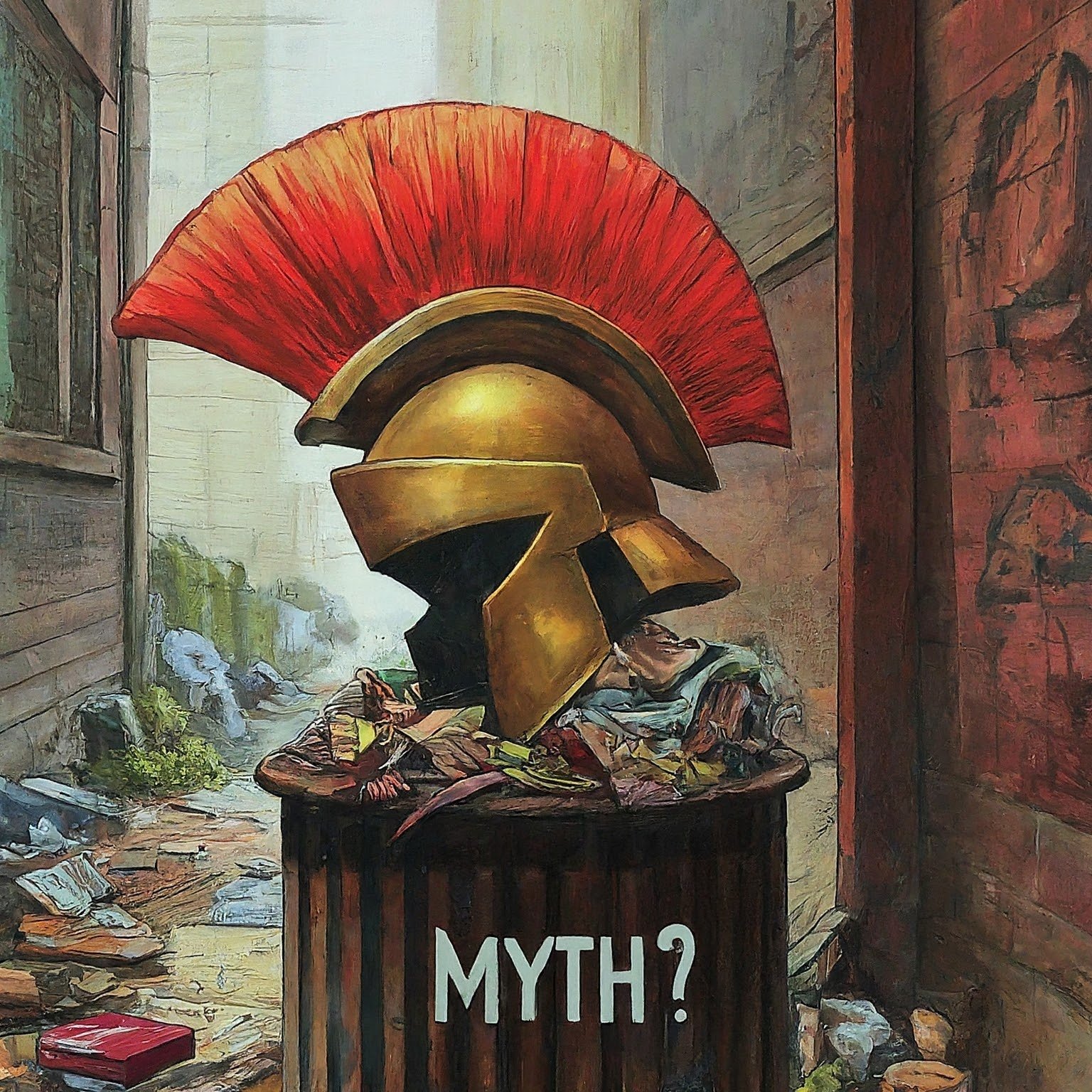
Think back to high school. You’re flipping through a textbook filled with Greek mythology – Zeus hurling thunderbolts, Icarus flying too close to the sun, gods screwing each other over in increasingly dramatic ways. These stories have survived for millennia. They predate modern nations. Entire civilizations organized themselves around them.
Here’s the question nobody asked you in class: Did anyone actually believe this shit?
Not “did ancient Greeks take these stories seriously” – of course they did. I mean: Did they think Poseidon was literally down there in the ocean with a trident, or did they understand these were stories that explained things, stories that gave structure to a world they couldn’t otherwise make sense of?
Because we’re doing the exact same thing today. We’ve just swapped out pantheons.
Meet the New Gods, Same as the Old Gods
We’re obsessed with superheroes now. Iron Man in his high-tech suit. Captain America with his shield. Spider-Man swinging through Manhattan. These characters dominate our culture – billions of dollars in movies, endless comic book runs, merchandising everywhere you look.
And we treat them exactly like the Greeks treated their gods: as vehicles for understanding the world and our place in it.
Don’t believe me? Look at the direct parallels:
Superman and Zeus – undisputed leaders, immense power, flying around above everyone else making judgment calls about who lives and dies.
Wonder Woman and Athena – wisdom and warfare packaged together, warrior women who embody strategic violence.
Thor and Hercules – powerful warriors with legendary weapons and strength, solving problems by hitting them really hard.
The Flash and Hermes – speed incarnate, messengers moving faster than comprehension.
Aquaman and Poseidon – rulers of the sea with tridents, because apparently that’s just what ocean authority figures carry.
These aren’t coincidences. We’re literally recycling the same archetypes, the same narrative functions, the same moral frameworks. We’ve just given them new costumes and different origin stories.
The Line We Draw (And Why It’s Bullshit)
Here’s where it gets interesting.
Nobody expects to see Spider-Man swinging from the Empire State Building. We accept superheroes as fiction – products of creative minds, entertainment, cultural touchstones that matter without being real.
But Greek mythology? That gets treated differently. It was written down in the Iliad and the Odyssey, epic poems that survived for thousands of years. It was the foundation of an entire civilization’s understanding of reality. Temples were built. Sacrifices were made. Wars were fought in the names of these gods.
So we give it weight. We treat it as something more than “just stories” because of its age, its cultural significance, its documented history.
But comic books are documented too. They’re mass-produced, archived, analyzed by scholars, adapted into films that gross billions. Spider-Man has been around for over 60 years. The mythology is elaborate, internally consistent, and deeply woven into modern culture. Kids grow up with these stories. Adults organize their moral frameworks around them.
What’s the actual difference?
Time? That’s arbitrary. Cultural impact? Both have it. Written documentation? Check and check. The fact that people believed one and not the other? That’s circular reasoning – we’re trying to figure out if people believed it the same way.
The difference is that we’ve decided one set of stories gets to be “mythology” (serious, meaningful, foundational) and the other gets to be “entertainment” (disposable, fictional, not real).
But they’re doing the same work. They’re serving the same function. They’re both frameworks for understanding morality, power, justice, heroism, sacrifice. They’re both teaching us how to be people.
We’ve Always Known They Were Stories
I don’t think ancient Greeks were walking around genuinely expecting to bump into Medusa at the market. They weren’t scanning the horizon for Pegasus. They understood these were stories – powerful ones, meaningful ones, culturally essential ones – but stories nonetheless.
The stories explained things. Why does the sun move across the sky? Apollo’s chariot. Why do seasons change? Persephone in the underworld. Why do we have laws and civilization? Because the gods demand order. These weren’t scientific explanations; they were narrative frameworks that let people make sense of their world.
Just like superhero stories explain things for us now. Why should we stand up to bullies? Because that’s what heroes do. Why does power require responsibility? Spider-Man taught us that. Why do we need to fight for justice even when it’s hard? Captain America embodies that struggle.
Same function. Different branding.
The Greeks documented their stories in epic poems. We document ours in comic books and billion-dollar films. Both get treated as cultural canon. Both shape how we think about right and wrong. Both feature beings with impossible powers doing impossible things.
The only difference is we’re honest about ours being fiction. Or at least, we think we are.
The Con We’re Still Running
Here’s what bothers me: We mock ancient people for “believing in myths” while we’re doing the exact same thing with different packaging.
We don’t call our modern myths “religion” so we think we’re immune to the same gullibility. But we’re not. We’ve just outsourced the function to entertainment instead of temples.
We let these stories tell us who to be, what to value, how to act. We organize our moral frameworks around fictional characters making fictional choices. We hold up Tony Stark’s redemption arc or Steve Rogers’ unwavering principles as models for how to live.
That’s not inherently bad. Stories are powerful. They’re how humans have always made sense of the world. But let’s be honest about what we’re doing.
We’re still looking at words someone else wrote and letting them define reality for us.
The ancient Greeks saw the Iliad and structured their understanding of honor and warfare around it. We see the MCU and structure our understanding of heroism and sacrifice around it. Neither group is touching the actual thing – just the story about the thing.
Stop Pretending There’s a Difference
If you can accept that Superman is fiction despite his massive cultural impact, despite the fact that millions of people have organized part of their worldview around what he represents, despite the elaborate documented mythology built around him – then you have to extend that same lens to Zeus.
Age doesn’t make stories true. Documentation doesn’t make stories true. Cultural significance doesn’t make stories true. The fact that people took them seriously doesn’t make stories true.
They’re still just stories. Powerful ones. Meaningful ones. Stories that shape societies and influence how we think and act.
But stories.
The power isn’t in whether Zeus literally exists on Mount Olympus or whether Superman literally flies around Metropolis. The power is in what those stories do – how they function, what they teach, how they shape us.
And the con is when we forget that’s what they are. When we mistake the story for the thing itself. When we let narrative override reality.
The ancient Greeks built temples to their stories. We build cinematic universes around ours. Different scale, same impulse.
At least be honest about what you’re doing. You’re not more sophisticated than your ancestors. You’re not less gullible. You’ve just got better special effects and more comfortable seats.
You’re still sitting in the dark, watching stories on a wall, letting them tell you how the world works. The cave hasn’t changed. The shadows have just gotten more expensive.






Leave a Reply