
I stumbled in on my kids watching Charlotte’s Web the other night – the original 1973 cartoon. I hadn’t seen it in decades, figured I’d sit for a few minutes, ended up watching the whole thing. And yes, it still wrecked me. That ending hits just as hard as it did when I was a kid.
But watching it now as an adult in 2025 America, I couldn’t help feeling something else underneath the tears: we are so dang screwed.
Not because of the story it tells, but because of what it reveals about us. About how easily we’re manipulated. About how readily we abandon our own judgment the moment someone writes the right words in the right place.
Charlotte’s Web isn’t a heartwarming tale about friendship. It’s a diagnosis of human gullibility. A diagnosis made in 1973 and one we’re still sick with.
The Pig Is Just a Pig
Let’s be clear about what actually happens in this story.
Wilbur is a runt piglet destined for slaughter. That’s what happens to pigs. They’re livestock. They’re raised for meat. The farmer isn’t a villain – he’s running a farm, trying to feed his family, doing what farmers do.
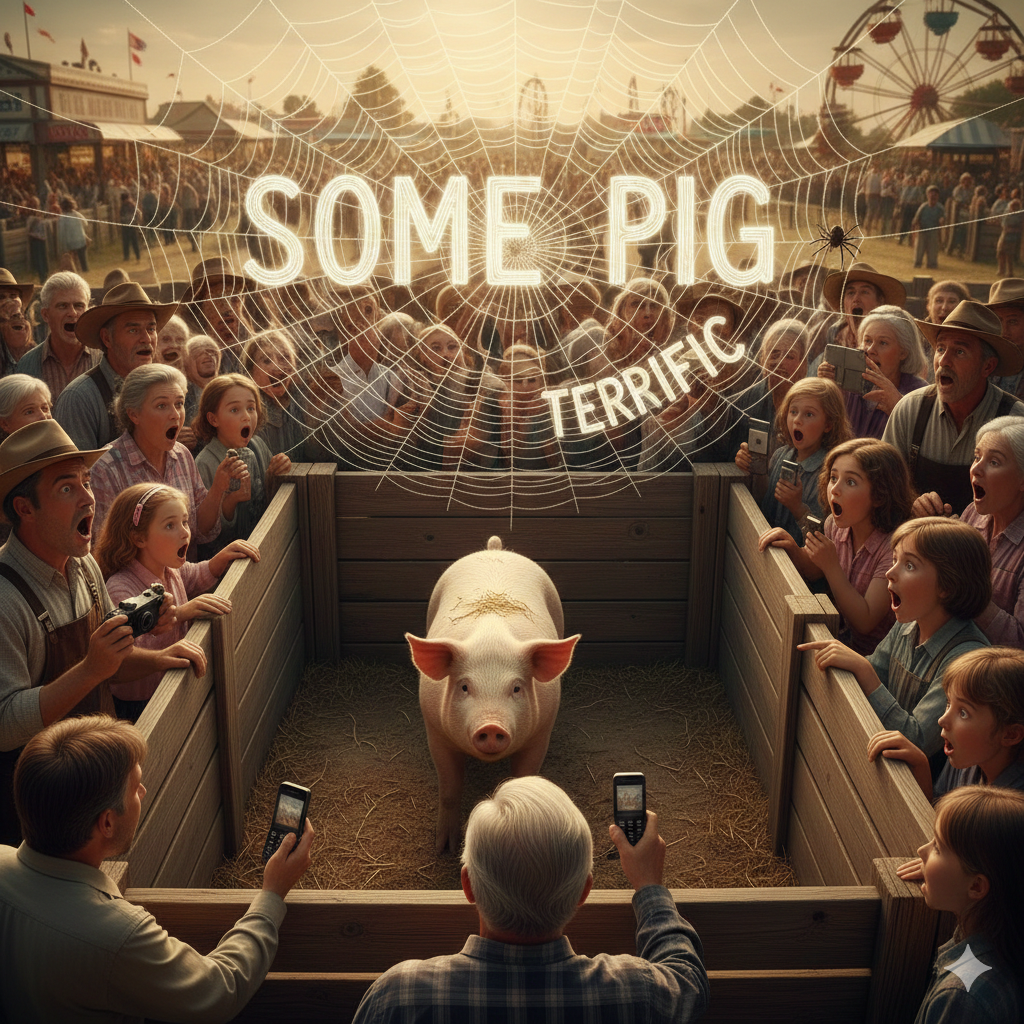
Charlotte the spider befriends Wilbur and decides to save him. How? By writing words in her web: “SOME PIG.” Then “TERRIFIC.” Then “RADIANT.” Then “HUMBLE.”
The humans see these words and lose their minds. They declare it a miracle. People travel from miles around to see the famous pig. Wilbur wins a special prize at the county fair. The farmer decides he can’t possibly slaughter such a special, miraculous animal.
But Wilbur didn’t do anything remarkable. He doesn’t display unusual intelligence or talent. He just stands there being a pig.
The words changed everything. The narrative changed everything. And the humans – every single one of them – fell for it completely.
A Spider is Writing Words and They Think the Pig is Special?
A spider – an invertebrate with a brain the size of a pinhead – is forming letters, spelling English words, demonstrating literacy and intelligence that would revolutionize our understanding of arachnid cognition, animal consciousness, and possibly reality itself. And they’re taking pictures of the pig.
The actual miracle is right in front of them – a spider’s web with words? Holy smokes! But they don’t t investigate. HOW did the words got there? They don’t ask. WHO wrote the words? They don’t care. They just accept the narrative the words provide and shift their attention exactly where the words direct them: to Wilbur.
And that is precisely how manipulation works. The real actor stays hidden while everyone stares at what they’re told to stare at. Charlotte controls the entire narrative and nobody even knows she exists.
This happens all the time. We see the effect and never question the cause. We accept the framing and never ask who built the frame. We read the words and never wonder who benefits from us believing them.
The farmer especially got screwed. He’s trying to run a business, feed his family, do his job. Raising livestock for slaughter is literally how farming works. But words appear and suddenly he’s keeping a pig alive indefinitely, eating the cost of feed and space and labor, getting zero return on his investment – because what? Some rubes were told that a pig is miraculous? He let external authority override his own judgment and needs and acted against his own material interests because he was spun a story.
And he never figures it out. None of them do. At the end of the movie, they still think it was a miracle. They learned nothing. They’re ready to fall for the next thing. What marks.
Charlotte Wasn’t Even Doing It For Him
But do you want to know the really uncomfortable part about this? Charlotte didn’t do it to help Wilbur; she did it to help herself. Don’t believe me? Then believe Charlotte when she admitted as much to Wilbur when she said, “By helping you, perhaps I was trying to lift up my life a trifle.”
Read that again. Charlotte isn’t saving Wilbur out of selfless love; she’s saving him because she needs her life to have some sort of meaning. She’s just a spider, she’s got maybe a few months to live, and she’s intelligent enough to grasp her own cosmic insignificance. That’s an existential crisis and she made Wilbur her solution.
He’s her legacy project. Her charity case. The thing she can point to and say “I mattered because I saved a pig.”
But here’s what really bothers me about Charlotte. She laid eggs. She had babies. 514 of them, in fact. She was literally creating new life, continuing her genetic line, doing the one thing that actually gives meaning to biological existence. For most creatures – for most people – becoming a parent is the thing that matters. It’s the ONLY meaning. Raising the next generation, passing on what you know, watching your children live on after you’re gone.
But that wasn’t enough for Charlotte. Parenthood – the realest, hardest, most meaningful thing she’d do – didn’t count. She wanted the performance, the spectacle, the grand gesture that people would marvel at. She needed you to believe that a pig was not a pig.
What does that say about her? That she’s so disconnected from what actually matters that she had to invent a false legacy while ignoring her real one? That she valued the opinion of humans who never knew she existed over the lives of her own children who actually needed her? That she wanted to make sure that you thought the pig was more than just a pig?
That’s not beautiful. That’s pathological.
We Are All the Humans at the Fair – And We Need to Stop
We are the humans at the fair.
We see words – in advertisements, in headlines, in social media posts, in expert testimony, in political slogans – and we let them override what we can see with our own eyes.
A brand writes “LUXURY” on a product and we pay ten times more for the same thing. A politician tweets “THE ECONOMY IS GREAT” and we doubt our own empty wallets. An influencer says “EVERYONE’S DOING THIS” and we fall in line. An expert declares “THIS IS TRUE” and we abandon our own risk assessment.
We need the Big Other – the external authority, the person writing the words above our heads – to tell us what’s real, what’s valuable, what matters. We can’t just look at the pig and decide for ourselves.
And just like Charlotte, the people writing those words usually have their own reasons. They’re building their brand. They’re resolving their insecurities. They’re managing their legacy. They’re selling you something. They need you to believe that they matter, so they can win.
The words aren’t about you. They’re about them. And you’re the pig.
Or worse – you’re the human staring at the pig, mouth open, critical thinking suspended, ready to believe whatever’s written above because thinking for yourself is hard and someone else already did it for you.
Think for your self.
Stop outsourcing your perception of reality to whoever writes the words. Stop letting external authorities – media, experts, brands, politicians, algorithms, whoever – tell you what’s true, what’s valuable, what’s worth caring about.
Trust your own direct experience over the narrative. If your wallet’s empty, the economy isn’t great no matter what the headline says. If the pig looks ordinary, it’s ordinary – even if someone wrote “TERRIFIC” above it. If the product feels cheap, it’s cheap regardless of the brand name.
Question who benefits from the story you’re being told. When you see words in a web, ask: Who wrote this? Why? What do they get if I believe it? Every narrative has an author with an agenda. Find them.
Look for the actual miracle, not the one you’re being shown. The spider that can write is more interesting than the pig that stands there. The cause is more important than the effect. Don’t let someone else direct your attention away from what actually matters.
Resist the spectacle. The county fair is everywhere now – constant noise, constant performance, constant THIS IS IMPORTANT. Most of it is designed to override your judgment and get you to consume, comply, or click. Don’t let it.
Reclaim your authority to determine what’s real and what matters. You don’t need external validation to know what you’re experiencing. You don’t need someone else’s words to tell you if something is good, true, or worthwhile.
A Pig Is Still a Pig
Stop being the humans at the fair. Look at the pig. It’s just a pig. Now look up at the web and ask yourself: who is writing this, and why do they need me to believe it?
No matter how many words you write, no matter how compelling the narrative, no matter how many people believe it – a pig is a pig.
The miracle was never real. It was always just a spider, some silk, and humans too desperate to believe in something bigger than what was right in front of them.
The words didn’t change Wilbur. They changed how people saw him. That’s the con. We let language replace reality. We let the story override the thing itself.
And we never, ever learn.




Leave a Reply